Egyptian Pyramids
Time: 7 minutes
What you need:
Scissors
Tape or glue
3D square-pyramid template—downloadable at bottom of the page
Crayons or markers for decorating
What you do:
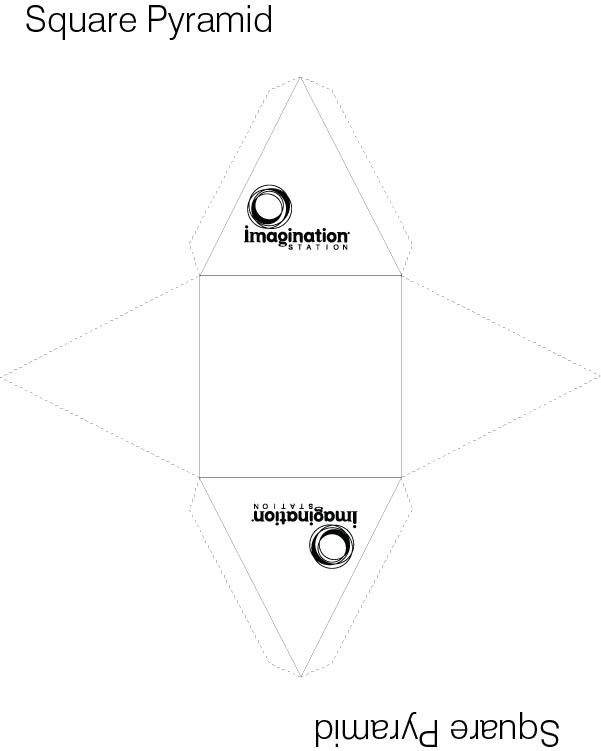
Download and print the square-pyramid template.
Cut out the template on the solid lines. These templates are examples of geometry nets, or flattened 3D solids.
Shade in the net to decorate it and make it look more like limestone.
Fold and crease on the dotted lines.
Bring the outside edges together to form the 3D shape.
Tape or glue the tabs on the underside of each face to finish your pyramid.
Questions to ask:
What 2D shapes did you see on this net before putting it together? How many of each shape are there?
Why do you think this shape is called a Square-Pyramid?
What other types of pyramids have you seen?
What's the science…and history?
The Ancient Egyptians are famous for constructing hundreds of pyramids starting around 4,700 years ago. These pyramids are still considered architectural wonders of the world today, due to their massive heights, which reach as high as 455 feet, and their precise alignment with the stars and Earth’s cardinal directions.
The Ancient Egyptians possessed a sophisticated understanding of engineering, astronomy and mathematics. They built pyramids as tombs for their pharaohs, believing that the tombs would ensure a successful journey to the afterlife. The four sloping faces are said to represent sun rays and connect to the Egyptian sun god, Ra.
Square-Pyramids are not entirely unique to the Egyptians; other ancient civilizations, including the Mayans and the Aztecs, built similar structures for various purposes. Triangles are often used in architecture even today due to their strength under pressure, which is part of how these enormous structures have been able to withstand the test of time.
Downloadable Square-Pyramid: